
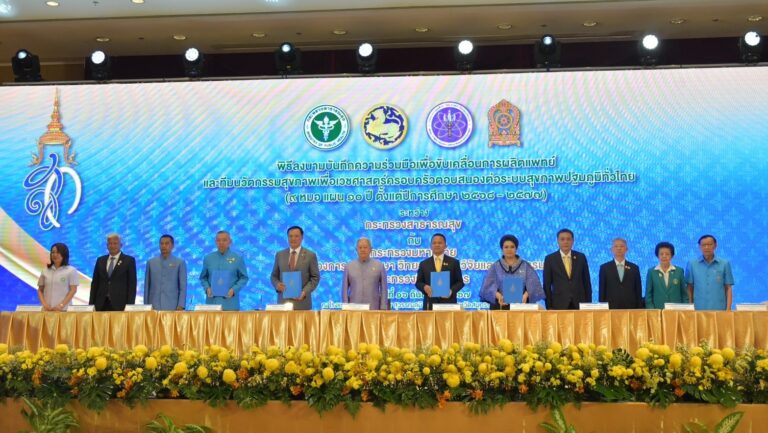
 The Nine Doctors pathway from medical training to community care317

PBRI SUSTAINABILITY
Policy
Praboromarajchanok Institute Regulations on the Code of Conduct for Institute Personnel, B.E. 2566 (2023)




Whereas it is appropriate to establish regulations governing the code of conduct for personnel of Praboromarajchanok Institute;
By virtue of Sections 19(2) and 24(2) of the Praboromarajchanok Institute Act, B.E. 2562 (2019), together with the resolution of the Institute Council at Meeting No. 13/2566 held on 9 November 2023, the following Regulations are hereby issued:
Clause 1 These Regulations shall be called the “Praboromarajchanok Institute Regulations on the Code of Conduct for Institute Personnel, B.E. 2566 (2023)”.
Clause 2 These Regulations shall come into force on the day following their announcement.
Clause 3 In these Regulations:
- “Institute” means Praboromarajchanok Institute.
- “Institute Council” means the Council of Praboromarajchanok Institute.
- “Faculty and Staff Senate” means the Faculty and Staff Senate of Praboromarajchanok Institute.
- “Administrative Division” means the Office of the President, a faculty, a bureau, or an administrative division otherwise named that has equivalent status to a faculty.
- “Faculty” means an administrative division whose principal responsibilities are producing graduates, providing teaching and learning, conducting research, providing academic services, and preserving and promoting arts and culture.
- “President” means the President of Praboromarajchanok Institute.
- “Dean” means the dean of a faculty within Praboromarajchanok Institute.
- “Bureau Director” means the director of a bureau within Praboromarajchanok Institute, or the head of an administrative unit otherwise named that has equivalent status to a bureau.
- “College Director” means the director of a college within Praboromarajchanok Institute.
- “Head of Unit” means a person holding a director-level position at the primary level or above.
- “Institute Personnel” means civil servants, government employees, Institute employees and hired staff working at Praboromarajchanok Institute.
- “Student” means a student of Praboromarajchanok Institute.
- “Ethics Committee” means the Praboromarajchanok Institute Ethics Committee.
Clause 4 The President shall be responsible for administering these Regulations and shall have the authority to issue announcements and orders for their implementation.
Where questions arise concerning the implementation of these Regulations, the Chair of the Institute Council shall have the authority to interpret or adjudicate such matters. Decisions of the Institute Council shall be final.
Chapter 1 — General Provisions
Clause 5 The code of conduct established under these Regulations constitutes standards of behaviour for Institute Personnel. It aims to preserve their dignity, reputation and honour, develop their capabilities, and foster public trust and respect.
Clause 6 Institute Personnel must strictly uphold and comply with the code of conduct established under these Regulations.
Chapter 2 — Code of Conduct for Institute Personnel
Part 1 — Conduct towards Oneself and the Profession
Clause 7 Institute Personnel shall uphold and stand firm in what is right, just and consistent with academic principles, without yielding to improper influence.
- Maintain good moral character and conduct themselves appropriately as Institute Personnel.
- Exercise their professional expertise honestly in performing their duties, without seeking or facilitating improper benefits. Where a professional code of conduct applies, they should also comply with that code.
- Maintain a positive attitude towards official duties and perform them efficiently and effectively, taking the Institute’s collective interests into account.
Part 2 — Conduct in the Performance of Duties and towards the Organisation
Clause 8 Institute Personnel should adhere to practices that promote social justice and uphold proper, ethical and desirable conduct.
- Perform their duties honestly and with integrity, without interests that interfere or conflict with the responsibilities of their position.
- Perform their duties transparently and in a manner that is open to scrutiny.
- Perform their duties to the best of their abilities, without discrimination or bias.
- Be punctual and perform their duties fully for the benefit of the Institute.
- Safeguard and use public property economically and efficiently, taking reasonable care to prevent damage or waste, as a prudent person would with their own property.
- Protect the Institute’s reputation, honour and interests. Refrain from actions that could harm the Institute, and do not improperly use its name or resources for personal or group benefit.
Part 3 — Conduct towards Supervisors, Subordinates and Colleagues
Clause 9 Institute Personnel should take responsibility for their work and cooperate within their units by sharing opinions, assisting with tasks, solving problems together, and proposing improvements to the work under their responsibility.
- Support one another in appropriate ways and promote unity and cooperation among colleagues in performing duties for the common good.
- Supervisors should attend to their subordinates’ work, morale and welfare, listen to their opinions, and exercise supervision based on sound principles, reason and ethical conduct.
- Subordinates must comply with their supervisors’ official orders that are lawfully issued in accordance with applicable laws and government regulations.If a subordinate considers that complying with an order would harm the public service or fail to protect its interests, they may immediately submit a written opinion requesting reconsideration. If the supervisor confirms the original order after receiving that opinion, the subordinate must comply.
- Treat colleagues and other associated individuals courteously, considerately and ethically, while maintaining good interpersonal relationships. Personnel must not sexually harass supervisors, subordinates or colleagues who are not their spouse.
- Do not present another person’s work as their own.
Part 4 — Conduct towards Students, Service Recipients, the Public and Society
Clause 10 Institute Personnel should conduct themselves in a manner that earns the trust of service recipients, students and the public.
- Serve students, service recipients and members of the public to the best of their abilities, with fairness, generosity, consideration and courteous behaviour and language. Where a matter cannot be addressed or falls outside their authority, they should explain the reasons or recommend the relevant unit or authorised person.
- Refrain from accepting property or other benefits exceeding the value ordinarily given by reasonable persons out of goodwill from students, service recipients, members of the public, or persons who may benefit from the performance of their duties. If personnel subsequently discover that something already accepted exceeds such customary value, they must promptly report it to their supervisor for appropriate action.
- Maintain the confidentiality of students, service recipients and members of the public who contact the Institute on official business.
- Treat students, service recipients and the public appropriately and ethically.
Part 5 — Conduct of Personnel with Teaching Responsibilities
Clause 11 Personnel with teaching responsibilities should fulfil the following duties:
- Inform students of teaching arrangements and assessment and evaluation methods at the beginning of the semester, within the period specified by the Institute.
- Select textbooks and teaching materials in quantities and at levels appropriate to the course content.
- Teach according to the scheduled timetable, do not abandon classes midway, and do not cancel classes without reasonable grounds. Where classes are cancelled, arrange replacement teaching.
- Teach to the best of their knowledge and abilities, without withholding knowledge or showing favouritism.
- Provide academic advice and other guidance necessary for students’ life at the Institute.
- Provide reasonable opportunities for students to meet, communicate with or seek advice from them, and maintain channels through which students can contact them when necessary.
- Serve as good role models for students and conduct themselves appropriately as teaching personnel.
Part 6 — Research Ethics
Clause 12 Personnel conducting research should observe the following principles:
- Maintain honesty and integrity in research and research administration.
- Possess the foundational knowledge, skills and experience relevant to their field of research.
- Act responsibly towards the subjects of their research, whether living or non-living.
- Respect the human dignity of research participants and comply with applicable professional regulations and rules governing research involving human subjects.
- Maintain independence of thought and remain free from bias at every stage of research.
- Use research findings for legitimate purposes.
- Respect the academic opinions of others.
- Take account of their responsibilities to society when conducting research.
- Recognise their research obligations under agreements with research sponsors and their affiliated organisation.
Chapter 3 — Proceedings concerning Breaches of the Code of Conduct
Clause 13 The Faculty and Staff Senate shall serve as the Praboromarajchanok Institute Ethics Committee. The Director of the Human Resources Division shall serve as its Secretary.
Clause 14 The Ethics Committee shall have the duties and powers to investigate facts, consider cases and adjudicate breaches of the code of conduct that do not constitute disciplinary offences, as follows:
- Consider allegations submitted by complainants or cases in which an apparent breach of the code of conduct comes to light.
- Appoint a working committee to screen allegations or complaints, collect and review information, and submit its findings and opinions to the Ethics Committee for consideration.
- Notify the person concerned of the allegations and conduct proceedings to determine whether a breach has occurred. The Committee may summon relevant persons to give statements or clarify facts, or require written explanations for its consideration.
- Notify the persons concerned of its findings and decisions regarding breaches of the code of conduct.
- Review, improve and establish guidelines and procedures for proceedings concerning breaches of the code of conduct, ensuring that they remain current and support the development of Institute Personnel’s capabilities in performing their duties.
- Consider and undertake other matters assigned by the Institute Council.
Clause 15 Three measures may be imposed for breaches of the code of conduct:
- A warning.
- An order to take corrective action.
- A formal written undertaking to refrain from further misconduct.
The Head of Unit shall consider and issue orders imposing the appropriate measure on a person who has breached the code of conduct, and shall report the action to the Ethics Committee.
A person subject to such a measure has the right to appeal to the Appeals and Grievances Committee within thirty days of receiving notification of the measure.
Announced on 26 December 2023.
Mr. Opas Karnkawinpong
Permanent Secretary, Ministry of Public Health
Vice-Chair of the Praboromarajchanok Institute Council
Acting on behalf of the Chair of the Praboromarajchanok Institute Council
Related News
Policy on Promoting Personnel Well-being at Praboromarajchanok Institute (Work-Life Balance)
5
8
10
Read news →

Educational Philosophy of Praboromarajchanok Institute
4
Read news →
Policy on Advancing Praboromarajchanok Institute towards a World-Class University for Primary Care
3
4
5
10
17
Read news →

Gender Equality Policy, B.E. 2569 (2026)
5
8
10
16
Read news →

Research Projects Subject to Full Board Review
4
9
10
16
Read news →


